Dear Mom and Dad…

Dear Mom and Dad,

I know it can be hard to read about your child experiencing pain – especially when they were under your direct care and supervision. I know this because I have my own children now – and I know how deeply I hurt when I see them suffer, and how it is my instinct not only to prevent them from suffering, but to blame myself for my inability to prevent it when suffering inevitably comes.

But, as you know, preventing our children from ever suffering is not our role as parents. Avoiding harm when we can? Sure. But it is not realistic or healthy for us to take on the responsibility of making sure our children don’t feel pain. What is our responsibility is teaching our kids how to suffer well. We allow our kids to see us suffer, in developmentally appropriate ways. We allow them to see how we handle hard feelings, and how we reconcile, and how we take what we’ve experienced and learn from it, and how we turn our pain into something beautiful and meaningful in the world.

The mark of good parenting is not an adult who never suffered as a child…it’s an adult child who knows how to suffer in a healthy way. In a way that not only benefits the adult child and the family but those who interact with them. A child who knows how to tap into support networks and community, and live into and process their suffering rather than hiding from it.

As an adult child, I will learn from your parenting. There will be things that I want to do differently. This is not because I believe that what you did was wrong…it’s because as much as I am like you, I am not you. As much as my children are like me, they are not me. We have to parent in a way that is cohesive with our own personality, values and convictions. My choices to do things differently affirm the most important thing you did right in your parenting – the most important thing that any parents can do right…

You made sure that we always knew you loved us – no matter what. That we could always come home – no matter what. You taught us that in explicit words – in conversations affirming that if we are ever in this or that situation, we could call you and you would come and pick us up. You taught us that in your actions – in giving us space to let us differentiate and grow into ourselves even when it was painful for you.

There are things that I will critique about my childhood experiences, because I am processing how the narratives I grew up with are and are not cohesive with my experiences and beliefs that I have developed. This is a normal and natural part of becoming an adult, and not a critique of you as parents (even though I may not be able to prevent it from feeling that way)…And I have the freedom and autonomy to do this while maintaining a close relationship with you exactly because you did parenting right. It’s because I feel secure that you will love me no matter what that I am free to explore and become and believe.

You did so well and I love you. I hope that my children will feel as unconditionally loved by me as I feel loved by you.

Photo by Michal Bar Haim on Unsplash

When Worry Won’t Go Away

This morning I saw a post popping around my newsfeed from a popular large, non-denomination church in Nashville that simply said, “Worship and worry can’t coexist.” Now, I’ll be upfront in saying that I didn’t listen to the message (though I intend to)…but my point here is not to critique it. In fact, I’m not really talking about the intent of that statement – I want to share with you what it brings up for me, and what I hope my anxiety-prone friends will come to see in themselves.

I have always been a worrier, and I come from a long line of them. The women in my family are smart, prepared, courageous and ready to anticipate what might be ahead. Couple that with some medical trauma I encountered as a pre-verbal child due to asthma and you have the perfect soil in which an anxiety disorder can grow. I never realized my anxiety was anything out of the ordinary. I remember nightmares from my childhood of monsters standing around my bed – and of jumping off the bed to run into my parents room so that no hand could reach out from underneath and grab my ankle. In those early years, it was pretty typical, magical kid-thinking. But the monster kept growing. Every time my parents left town, I assumed that they were going to die while they were gone. Every time I had a big or exciting event coming up I assumed that something would happen to me before it took place. Every night I laid in bed afraid that someone would break-into the house – just waiting out the fear until I finally fell asleep. I was anxious about how I was perceived, quiet in class, found it difficult to make new friends, and was constantly imagining catastrophe. Here’s the thing. I heard all of these messages telling me that my anxiety was somehow my fault… I didn’t have enough faith, I wasn’t “casting my cares” on God enough, I wasn’t trusting enough, etc. Sometimes these were explicit, but sometimes they were implicitly woven into the fabric of everyday conversation.

Going to college didn’t help, except to bring to light that some of my fear was very much abnormal. My new friends thought it was funny and gave me a hard time about what a scaredy cat I was, and it became a part of my identity. I was once again the quiet one in class, but what only my close friends knew was that it killed me to be so quiet. I wanted to speak up so bad and I had so much to say, but I just couldn’t. I would beat myself up constantly, and write in my journals about my goals to “say one thing in class today” and to stop being so afraid. I read Tillich’s “The Courage To Be” hoping to find some nugget to jolt me out of my fear. By the time I graduated, I came to the realization that fear ruled my life and my decisions…but the messages never changed. I needed to work harder at it. I needed to be braver. I needed to have more faith. I needed to be better than this. What was wrong with me that I was so afraid all the time. I internalized ALL of it as a character flaw – as my main character flaw.

Anxiety affected every facet of my life, but I managed and internalized it fairly well (so that others couldn’t see the depth of my suffering) until I went through significant trauma around the birth of my children. When Micah was born I had severe pre-eclampsia that continued into a very scary bout with pulmonary edema after delivery. After Remy was born (most people don’t know this) I got to take an ambulance ride to the hospital and leave my six day old baby at home with my mother because half of my face was paralyzed and we thought I was having a stroke. I kissed that baby goodbye and thought it was forever. People…just so you know…that’s trauma…(sometimes we think our trauma somehow doesn’t “qualify” as trauma because other people have experienced so much worse…and this is incredibly dangerous because trauma needs to be stabilized and reprocessed, not repressed or ignored or downplayed…). After an overnight stay in the hospital, away from my newborn and toddler, I was told by a neurologist that I had a lesion on my pons that was most likely multiple sclerosis. I was set up with a specialist and sent home to process the diagnosis while I awaited an appointment. To make a really long story short (maybe I’ll share it all another time)…I do not have M.S. Two years of follow-up MRI’s and doctors still don’t have a conclusive answer for what is on my pons – but their best estimate is that it was a tiny vascular incident.

All that to say, this trauma took my tiny little anxiety monster and grew it epically. I started therapy to process the trauma right away. I spent countless nights awake, thinking I was having a heart attack. I googled and became frantic that I had a tumor in my brainstem. I was worried that it would happen again and I would become locked in. What if it wasn’t M.S. but what if it was A.L.S? I spent hours hiding in the bathroom googling and panicking. Here is the thing – I was legit having all sorts of physical symptoms. I had actual twitching in my fingers, and numbness and tingling on my left side. I had throbbing pain in my arm and cognitive disturbances. I had panic attacks that sent me to the emergency room. Guys, it was SO awful.

And because of all of these messages I internalized over the years, I still thought it was somehow my fault. I wasn’t brave enough. I didn’t have enough faith. I wasn’t mature enough. I was too scared.

I missed out on so much of my life.

After two years of therapy and yoga (both of which I still do, and both of which have been invaluable to my recovery) I finally “gave up” and started on an SSRI. Y’all…this is one of the hardest decisions I’ve had to make for my health. I was SO terrified about this medication. What would it do to my brain? What would it do to my creativity? What kind of side-effects would it cause?

It takes a solid eight weeks to adjust to an antidepressant medication…and it was a really rough eight weeks. But I have to tell you, I feel like I have been reborn. For the first time in my life, I don’t lay awake at night worrying about what is going to happen to me while I sleep. I don’t worry about what is going on in my brain. I haven’t had a single panic attack. While I still fret from time to time, I don’t obsess and ruminate about things. You guys…I am living without severe anxiety for the first time in my whole life and it feels so amazing.

I’ll go more into this someday but I wanted to write this post for several reasons. First, maybe it’s true that worry and worship can’t coexist…but that doesn’t mean you have to fix your worry so you can worship…There are a lot of ways to treat anxiety outside of medication that work for many people…but you can’t “will it” away or “trust it” away…or dare I say, “pray it” away… If your anxiety was clinical, as mine was, you have to attack it head on…and realize that it’s not a character flaw. It’s not something you’re doing wrong or something you need to get better at. When I started taking that pill, all of that hard work I was doing in yoga and psychotherapy and faith was finally able to make a difference for me…Bottom line, sometimes it’s a chemical thing. Second, I think that “worry and worship” phrase can sort of insinuate that your negative feelings aren’t welcome before God…which is something else I find extremely damaging…but we can get into that another time. Third, I wanted to make this public because I had so much shame around starting this medication. It was reading someone else’s facebook post that I respected, and seeing how she was vulnerable about her use of medication, that finally gave me the courage to try. That post changed my life, y’all. This is extremely long, so I will cut myself off for now.

Photo by Sarah Diniz Outeiro on Unsplash

“I {don’t} have the best words”

You see something on Facebook that makes your blood boil. “How can people still think like this,” you wonder aloud. What do you do? Do you call a friend to vent? Do you leave a scathing comment? Do you use an angry face emoji and then walk away, still fuming over it as you go about your day? Do you go to your own profile and post a passive aggressive plea for decency in the face of “such nonsense”?

I have done all of those things…multiple times.

When I post my own political or religious thoughts, and someone comes and likes it or comments in support, I get a little bit of a rush. We really like it when someone validates our deep need to feel like we are good – to feel like we are on the “right side.” There certainly is objective evil and injustice in the world, and we should speak out against it. I am simply inviting us get creative in how we engage with one another.

Next time you see a post like that (especially if it is someone you know or care about), I would invite you to look at it this way. What are the feelings and emotions behind the person’s words? Is it possible for you to look at the feelings (not the words or content) objectively? Could it be that what looks like blatant racism (and probably is) is also a human trying to communicate fear or loss in some way – this doesn’t make it ok, but it may make it easier to dialogue with.

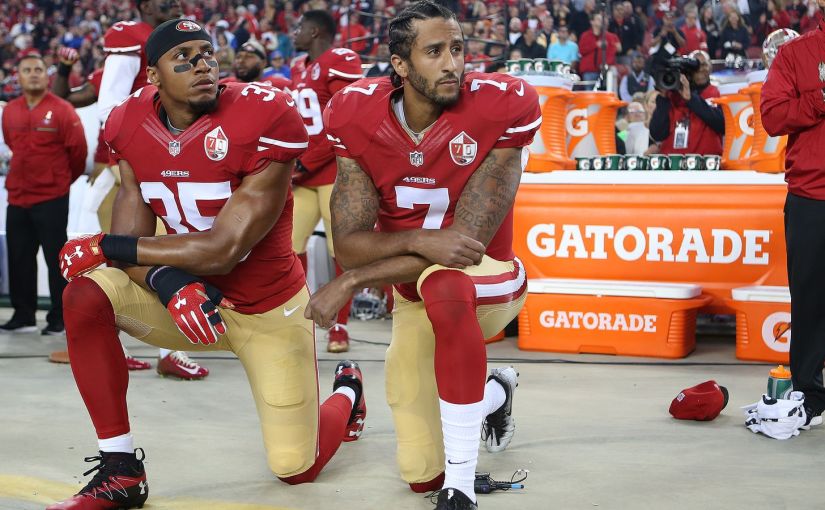
Let’s look at a particular example. A couple of weeks ago, when my Facebook feed was filled with friends posting angry words against those kneeling during the national anthem, I had enough. I got mad, I sat down to my computer and vented in a Facebook post. As comments came in, most were positive but a few were negative. Some were even downright personally hurtful…but instead of biting back, here is what I chose to do. I chose to sit and think about how my angry friends were feeling. What experiences, relationships, and suffering have they endured that have led them to this space? These are generally very kind people – they must have been feeling hurt to respond in such a hurtful way. I apologized where I felt I had inflicted harm in one way or another, and I continued to advocate for what I believed to be true.

Looking at these feelings allowed me to see beyond what my friends were saying, and to attempt to respond appropriately to their feelings, without conceding the argument. I am not saying I did any work towards changing anyone’s mind – because I am not delusional – but my hope is that I can model a style of respectful dialogue in which people who differ greatly politically and religiously can still form meaningful relationships (without sacrificing their convictions). I know enough to know that face-to-face relationships with people who are profoundly different from yourself are how your opinions and perspective broaden, and not persuasive arguments. It’s hard to hate someone up close.

I want to clarify that for those who have been marginalized, abused or oppressed, I am not asking you to empathize with your oppressor. What I am doing is trying to promote a new way of communicating. Sometimes it feels like language just gets in the way of communication.

So, how do you discern what sorts of feelings might be behind someone’s emotionally charged post? First, you use your imagination. You do what you can to climb inside their mental perspective and explore for a bit. Second, and perhaps most importantly, you ask them. Instead of responding to something with a scathing counter-attack, maybe ask them how they formed their opinion. Become a scholar of the people in your life. If we never learn how to hear each other…the needs people are communicating with their words and actions, rather than the actual words they have chosen to say…none of this division is going to get any better.

Just because you can’t see it…

The black bin is for trash and the white is for recycling. Ever since we moved into a home with curbside recycling, I have learned the joy of sticking something in the white bin. Each item that goes into the white bin instead of the black bin is a tiny victory. “I’m not being wasteful with this,” I think to myself triumphantly (of course I should be celebrated for putting the milk carton into the recycling…) The truth is, before we bought the white bin we were often to lazy to walk the milk carton out to the recycling can in the garage – so it went in the black bin more often than not. We have put so much space between us and what happens when we throw things away. Have you ever sat down to ponder that? (What – you mean you don’t spend your free time thinking about trash?) I have become so cognizant that everything I put in that black bin ends up in a dump. “It’s just the way it works,” I say to soothe my self, “everybody creates waste.” While this may be true, and I am not advocating an attitude of guilt, I can’t help but wonder how my habits would change if that landfill was my backyard (or heck…even just in view of my home). Would it change the items I choose to buy? Would it effect the length at which I go to avoid throwing things out? Would I take the extra time to recycle, to give away, and to learn how to compost everything I possibly could?

Last weekend I was in Chicago to see Hamilton (“cuz I am not throwing away my – shot”) and spent a decent amount of time on the train. During one particularly long and uncomfortable ride, we sat across from a boy, who couldn’t have been more than eighteen, with long, curly blonde hair. At first I thought he was asleep…but then I noticed the thick line of drool connecting his mouth to the pull of his zip-up hoodie. This kid was strung out – on what, I’m not sure – but he kept coming in and out of consciousness. Overtime he woke he put a large chunk of pink Laffy Taffy in his mouth and then his head drooped once more and he was out. I couldn’t stop thinking about my beautiful blonde-headed boys at home – or about friends who have struggled with substance abuse. Chicago was hard. It was hard to see pain like that on seemingly every train and every corner. I came home thinking that as much as I loved the city, there is no way I could live in a place like that. “I can’t see that every day,” I thought.

Just because we can’t see it doesn’t mean it’s not there. We have created so much space between ourselves and discomfort (by we…I mean people like me…I know there is a lot of privilege in that “we”…and I won’t define it for you). We throw things away in our black bins, and someone “magically” comes to remove it from sight, never to bother us again. We live in a really safe suburb. I eat meat from animals that I didn’t raise, that I didn’t slaughter, or process, or deliver. When I feel pain, I take medicine so that I don’t have to feel it anymore. I didn’t have to sweat over the land that grew my food, or dirty my hands in the soil, or break my back harvesting it. I buy clothing that I like and that’s cheap without thinking about who made it or what their working or living conditions are. It is so easy to distance ourselves from discomfort (if that’s not the most privileged statement I’ve ever typed), but again, just because we can’t see it doesn’t mean it’s not there.

Maybe sin is the cumulative effect of thousands of daily acts of negligence…of putting space between ourselves and creation…of putting space between ourselves and God in the “other.”

How can we become mindful and compassionate with our actions and choices? How can we avoid paralyzing guilt so that we can continue to do creative and generous work in the world? These are some of the things I’ve been pondering today.