Why I left…

The story of non-denominational accountability…or lack thereof…

It was about 7am when I finally left the church after working through the previous day and night on recreating the children’s ministry large-group space. I didn’t even leave to go home – just ran a quick errand to home depot and headed back to the church, where I would continue to work until 5pm when my team hosted a parent’s night out. It was the longest work day… probably about 36 hours. That was the longest single stretch I’d stayed at the church, but it was only one of innumerable times that I worked crazy hours for the sake of ministry. These are the costs of ministry, of course, that you would work long hours with little pay because – of course – “it’s a calling.”

It is a calling, and I loved my calling. I loved my congregation truly and deeply – so much so that I was willing to filter what I needed to filter, go above and beyond in whatever way was required of me, and basically, bleed myself dry.

My time in church ministry was the best and the worst. I served with some of the most incredible human beings, both staff and volunteers, who taught me and loved me well. We got to create and innovate and learn and grow together. We tried new things, took risks, and launched into the unknown together – and I am forever grateful for my experience – especially the relationships that are still SO meaningful to me today.

But, as is common with large institutions, things weren’t always so great under the surface. I don’t want this to be about assigning blame or shame to any one person, but it is my story and I also feel like two years is long enough to wait to tell it.

So here goes…

Cut to my actual church experience. I started as many people do – a student ministry internship. During the last year of my religious studies program I served as a student ministry intern – writing small group curriculum, building relationships and investing in the lives of teens – and generally making myself available to serve in whatever capacity necessary. When I finally graduated, I begged for a job so that I could stay at the church – partially because I loved the church, and partially because I was in love with Ryan (though he didn’t know it yet).

Some circumstances colluded (and I know a lot went on behind the scenes on my behalf) and I was offered a job as an administrative assistant. Now, this was not an exciting role for me, but it was people and a place and a congregation that I loved – so I didn’t really care what my role was. I threw myself into it, and I did my best to lean into the pastoral part of the role – volunteer recruitment and empowerment as well as teaching…even if it was teaching three and four year olds. I was the lowest on the totem pole, but it was my very first real job. I worked SO hard and threw all of my energy and effort into it. I learned how to deal with difficult people…those who would pull you aside in the middle of a VBS (for which you and your team had written 100% original content in addition to all of the other functional tasks) to tell you… “you know…you could have just purchased something from lifeway…”

The week Ryan and I returned from our honeymoon, there was a restructuring. We had a new boss, and everything started to change. We watched as our new boss went through candidate after unqualified candidate to fill the position of children’s pastor…a position that Ryan and I were already filling in function (Ryan with elementary and me with preschool). I spent so many days in tears before walking into the building. What was wrong with me? Couldn’t they see that I was already doing this job? Was I really that bad at it? They weren’t giving me any feedback to that effect, but that is all I was left to conclude. I wasn’t enough.

Eventually, they gave up the search and allowed Ryan and I to team lead the ministry. We didn’t get a pastoral title, of course, but at least we were able to do the job. We worked. We worked so hard and with all of our energy. We weren’t perfect, we didn’t do everything right, and neither of us was particularly passionate about children’s ministry specifically, but gosh if we didn’t give it everything we had. We built amazing and deep relationships with volunteers and parents. We did everything on a shoestring…half the time we didn’t have the money to purchase supplies, so we had to edit the curriculum to make sure it was as cheap and efficient as possible. We cut out snacks….we limited crafts…we sold off toys so that we could buy the things we needed. The money was just always that tight…but we found a way to be present in our ministry anyway.

Then,  when things were going really smoothly in the preschool ministry and volunteer leadership was empowered throughout the program, we launched a new campus. This new campus was at a really trendy new facility…a cool sanctuary for sure…and the kids got to be in the hallway at the school next door (yeah…the hallway…) I wanted to grow in my skills and to learn from people who had previously planted a church, so I offered to be the volunteer coordinator for all of the ministry areas (except worship arts) at the new campus. I organized the coffee folks, greeters, set-up and tear-down team, as well as the “children’s ministry hallway” team. I did the volunteer recruitment, encouragement, empowerment and leadership. I did the ordering and purchasing, the follow up and contact with new visitors. Often, I was the one who unlocked the building in the morning and the one who was there to lock up at the end of the day. I got to watch as people who were much higher in the organization than I was rolled in an hour later than I did and then complained about things constantly. As things started to go south due to a lot of different factors that aren’t the story today, I got to read a survey written by one of the volunteers that said, “I don’t know why you are asking volunteers to do all these things…this is the staff’s job…this is what they get paid for…you shouldn’t be asking us to do anything.” Again, I cried my eyes out. Here I was, still making next to nothing and no one saw me. Or, at least, the people in the organization that had all the power didn’t see me.  (This survey respondent, by the way, was eventually given even more power within the organization…)

Throughout my time of working two jobs for the organization, my full-time children’s ministry role at the main campus and volunteer coordinator at the second campus, my compensation didn’t change one penny. Not only that, no one even said so much as “thank you” or acknowledged all of the extra work I was putting in. I still wasn’t enough.

But I stayed. Because I loved the church. Because I loved the congregation. Because I believed in what we were doing and who we were trying to become.

I was finally able to transition out of children’s ministry and into small groups – which is what I always felt passionate about. I dove in and, once again, gave it all I had. I was new to that role, but I wasn’t new to ministry or to people. We began to grow our small groups program, take risks and try new approaches. I was told that I would have this position on a trial basis…because I had to prove myself. That if I eventually proved myself, then maybe there would be a title or compensation change. I will say, I was given some flexibility in my schedule here given the fact that I had just given birth to my first son – and I was very grateful for that. But I still wasn’t enough…not really. Not more than a few months later, I was told that the organization would be restructuring and I needed to decide which pastor I wanted to be an assistant for. TO BE AN ASSISTANT FOR. I was humiliated. That restructuring never really fully came to pass, fortunately, but it still drove the message of not enough even deeper.

When things started to get really tricky regarding finances and attendance, the church wisely sought some outside counsel. We had this big staff retreat with a church consulting firm and talked about all the things that were right, wrong, confused and missing. Almost immediately, those guys saw me better than the leadership did. By the end of the retreat, I had some new leadership responsibilities and was invited to join the pastoral team. Well…I still didn’t officially get the pastoral title via HR paperwork…and there was still no change in compensation, but I did get all of the responsibilities of a pastor. Oh, and I gave up my schedule flexibility so that I could be more present in this “new role.” I was told, time and time again, that once I proved myself maybe there would be some change. But it never happened.

Here I was, ten years into ministry making barely more per year than I did as a fresh college graduate administrative assistant. Here I was, giving everything I had for the sake of a leader who didn’t really see me.

So what was I to conclude? I mean, I was never given direct feedback about why I made at least 40% less than any other person (all men) on the pastoral team. Was I really that bad at my job? Was something wrong with me? Was I not mature enough? Was I not pretty enough (believe it or not…I had reason to believe that it might be a factor)? Was I not trendy enough? Why on earth was I not enough?

I internalized it. And I started to believe that I was, in fact, not enough. Not only that, but I didn’t know what it was about me that was lacking, so I didn’t know how to “work” on it.

I finally started therapy, for something completely unrelated – and began to unpack some of these feelings of “not enough” that I was encountering in my professional life (but lets be honest…when your professional life is the world of faith and ministry, it is incredibly personal too…). After processing through all these stories, and a bunch more that I won’t share publicly because they are not completely mine to share, my therapist was appalled. I was in the midst of a toxic environment and I didn’t even know it. I was blinded. By my love for the work, my love for the congregation, and my loyalty to what we were trying to build. I finally grew a spine, and planned and executed a conversation with leadership about boundaries. I said that it wasn’t right, the way I was being treated. That I had waited two years for this compensation change after being added to the pastoral team, and that the pay inequity was not ok with me.

I had one of the most vulnerable and difficult conversations of my life. And it was miserable. I was told things like, “wow, if the title is that important to you – then I guess we can fill out the paperwork. That kind of thing just isn’t that important to me.” You know what, maybe that’s because you didn’t spend your life being told you weren’t “enough” to be a pastor…or grow up as a woman being told that you were, in essence, disqualified from birth. I was told that with the current financial situation, though they wished it could change, there wasn’t anything they could do or promise that they could make about it in the future.

But I knew better. I knew that money was on the decline with the attendance…but I also knew where the money went… (the books are open, folks…you can ask to see them any time…)

So I told them I would have to hold my own boundaries and remove myself from the situation. And that is what I did. I left the church that I loved – that felt like family. I left the organization whose mission had become my life’s work. I left the city that felt like home and the pastoral identity I had tried so hard to cultivate and I started over.

And it has been hard. And I have been bitter. And I have been so filled with anger. But, you know what, I am also starting to feel full of life again. I stood up for myself. I said, you know what, no matter what you say I know I am enough. I get to decide whether or not I stay in a situation that invalidates my worth – and I am proud of my decision to risk it and believe in myself.

And I want to say this. I just didn’t want to be silent about it anymore. I have SO much love for the organization, despite it’s faults. I have so much love for the leadership, despite their faults. I was formed there. I didn’t and don’t want to hurt anyone, because, honestly…as hurt as I have been and as much as I feel wronged, I don’t believe in my heart that it was intentional. I don’t. Maybe that’s naive, but I believe the best of these people. I know they were doing their best, but there still has to be accountability.


 

Photo by NeONBRAND on Unsplash

{re}image advent | 12.5.17

Waiting can be excruciating…especially if you don’t know what you are waiting for. One of the hardest things for me about Advent in the midst of my spiritual dessert was the loss of hopeful anticipation.

The Christmas season has always been, for me, marked by magic and hope and love, and the anticipation only made these feelings grow. There was a sense that somehow I was cosmically connected to those people who thousands of years ago were waiting for God’s incarnation. They were waiting. They were watching. They had hopeful anticipation. And many of them did not even recognize it when it came.

No matter if you look at the Christmas story through the lens of historical fact, tradition, or prevailing myth – there is something to learn here. First, often times the Divine shows up in ways we are not immediately able to recognize. Conversely, that means that it might feel like God is missing when, really, we are just looking for the wrong thing.

Second, it is possible to have hopeful anticipation even if you don’t yet know what you are anticipating. Liminal space, the space between the end of one life season and the beginning of another, can be simultaneously the most painful and most generative of times. It is in these spaces that we “become.” The old structures are stripped away and the new are slowly, but surely rebuilt – leaving us vulnerable and open and malleable in the process.

I want to encourage you, friends, to join in on the hopeful anticipation. It is ok to walk in this mystery even if you may see it differently than those around you, or than you have in the past. It is ok to wait expectantly for something unknown. It is ok to shout out to a seemingly-empty universe that you are waiting for something. Just don’t be surprised if the response comes in unexpected packaging.

Love, joy, and strength to you all today, friends.

{re}image advent | 12.4.17

We like to have boxes for things. We are good / they are bad. This is home / that is away. I like this / I don’t like that. But what happens when things don’t fit into our boxes – if our brain can’t find a way to clearly categorize our experiences? For example, when a person has died but their body is still there with you…they are there, but yet somehow, they are also not. Or…when you are driving around a city that you once called home – that really felt like Home…but it’s not where you live anymore. I find my brain constantly analyzing all the reasons I miss Nashville, the ways in which our new living situation has been healthy and life giving, the pros and cons of every tiny detail. It is exhausting. Maybe Indiana can be Home and Tennessee can be Home – maybe it’s not either/or. This place, which held some of my best and some of my worst moments can just be what it is – a really meaningful place in my life. It doesn’t need to go in a box, and I don’t need to make sense of it. When you lose something you love, whether by circumstance, choice, or tragedy, there is grief – and grief can cause overwhelming sense of confusion, tension, and conflict. You can see sadness and relief and extreme suffering and joy all within a breath. And that’s ok. This season isn’t all good or all bad. This moment isn’t all good or all bad. And I would invite you to stop trying to fit it into one of those boxes. Instead, use that energy to just be present and experience the moment – the joy and sorrow, the relief and sadness. You don’t need to judge it, categorize it, or understand. You don’t have to assign it value or compare it to other moments… you just have to live it ❤️

Photo by Joshua Ness on Unsplash

{re}image advent | 12.3.17

I plopped into the chair, feeling the full weight of my body collapse beneath me. It was my first time in therapy, and I wasn’t sure what to expect each week. What I did know, however, was that I had a lot of work to do. I was unpacking and processing trauma from my recent birth, and at the same time going through my own internal spiritual migration. My amazing therapist was both a spiritual director and an LCSW certified in EMDR, so I knew she was just the right fit for me.

Before I placed the headphones on my ears to begin my first EMDR experience, I was directed to picture myself at a beach. I was to place myself at the beach and wait for God to meet me there. Feeling vulnerable and self-conscious, I committed to the exercise. I deeply inhaled the salty air and felt the breeze in my mind…and I waited. I waited and waited for God to come…but no one came. I sobbed in my therapists office that day, feeling deeply betrayed. I had devoted my whole life to God, and God couldn’t even show up for me when I made myself vulnerable to the Divine presence for the first time in a long while.

I drove home in a daze – angry, confused, and sad.

That night I had the most vivid dream. I was walking through a dense fog, and suddenly, I saw the head of a deer popping up through the murky white and looking at me intently. The deer went back to eating the grass, and I woke up.

As I awoke, I had an unmistakeable feeling that I was in the Divine presence. I felt an indescribable peace, and I knew that this dream was a mystical experience. I realized that day that God had not failed to meet me…I just wasn’t looking for the right image.

My spiritual life to that point had deeply embedded within me a metaphor of God as a man. I was sitting on that beach during EMDR waiting for a man to come and talk with me…but no man did. However, God met me in the fog. I realized that while my functional metaphor of God as a man no longer made spiritual sense to me, God was still there in the fog.

The new metaphor showed a side of God that permeated everything – that I could inhale into my lungs and exhale back into the world around me. This metaphor described a God that was immediate and present, and mysterious. A God that ebbed and flowed and existed right in the midst of the mess of the world – a constant, peaceful, permeating presence.

Sometimes our metaphors for God break down and no longer serve as a way for our human mind to dwell in God’s presence…but that doesn’t mean God is absent. Sometimes we are just looking for God in the wrong places, the wrong images, the wrong metaphors. Next time you feel a Divine absence, take some time to examine the images you are trying to recognize, and maybe make yourself open to the possibility that God is revealing God-self to you in a completely new way.

Photo by Paul Earle on Unsplash

{re}image advent | 12.2.17

My gift to you today is this song, which has carried me through my winter for years…

SNOW – by Sleeping at Last

“the branches have traded their leaves for white sleeves all warm-blooded creatures make ghosts as they breathe scarves are wrapped tightly like gifts under trees christmas lights tangle in knots annually

our families huddle closely betting warmth against the cold but our bruises seem to surface like mud beneath the snow

so we sing carols softly, as sweet as we know a prayer that our burdens will lift as we go like young love still waiting under mistletoe we’ll welcome december with tireless hope

let our bells keep on ringing making angels in the snow may the melody disarm us when the cracks begin to show

like the petals in our pockets may we remember who we are unconditionally cared for by those who share our broken hearts

the table is set and our glasses are full though pieces go missing, may we still feel whole we’ll build new traditions in place of the old ‘cause life without revision will silence our souls

so let the bells keep on ringing making angels in the snow may the melody surround us when the cracks begin to show

like the petals in our pockets may we remember who we are unconditionally cared for by those who share our broken hearts

as gentle as feathers, the snow piles high our world gets rewritten and retraced every time like fresh plates and clean slates, our future is white new year’s resolutions will reset tonight”

Listen to the song, discover the wonder that is sleeping at last, and read the story behind the song here…


Photo by Aaron Burden on Unsplash

{re}image advent | 12.1.17

I am staring out my bedroom window at a tree – a tree that less than a month ago was covered in bright red, beautiful leaves…but now appears as naked brown sticks. Empty. Fragile in the cold. The heavy branches are still beautiful in their own way, and I watch the lines trace up from the trunk reaching up and out toward the sky. But I know a secret about this tree…because I have seen this before. What is inside those branches is not death but life. A few months from now this same tree will spring forth with green leaves and provide shade for my family. The birds whose nest is so visible now will return to their well hidden home to create their own new life.

I have just come through a spiritual winter and am stepping into a new spring. The life is buzzing all around me now, but not long ago I felt empty and fragile too.

I have a secret for you too… There is still life inside you. Take a deep breath in and feel your lungs expand. You are still here, and someday you will feel full and whole and alive again. Someday you will be able to provide those around you with warmth and a place to come home to, and it will be so good. It will not be the same as it was, but it will be good.

In the next twenty five days, I hope to help stir some of that life up through songs, poetry, art, and the experiences of others.

Keep showing up, my friends. Even if showing up is all you can do right now, that is the first step…


Photo by Emanuel Hahn on Unsplash

Tribe vs. Tribalism

For a while, I considered myself an expert on community. As a groups pastor, that was the “commodity” I was responsible for. I developed groups, wrote curriculum, and spent my time and energy investing in ways to help people create intentional community. I immersed myself in the study of shame and vulnerability and in group processes and dynamics. I was given the ironic task of trying to “programatize” one of the most basic of human connections…gathering with neighbors for dinner. I, myself, was a member of the most amazing small group – we cared for each other, supported each other, walked together through tragedy and joy, shared our pain and shame, and loved each other well. I spent all of my professional energy trying to figure out the sacred formula to duplicate this in other group settings…I had found my tribe, and in the process I learned that we all need a tribe.

Tribes aren’t inherently bad. We need to find our tribe. We all need a place to be messy and raw and real and find acceptance right where we are. We need people to cheer us on and love us when we are at our very worst – when we have trouble feeling lovable.

But there is a very thin, yet distinct, line between finding your tribe and toxic tribalism. A healthy tribe is a launching pad and a safe place to land. It allows us the relational security to take great risks and grow and learn from them. The healthy tribe propels us outward – to take a leap forth from our place of security and endeavor towards great love, great service, and great sacrifice. There is authentic and intentional love within, and that love spreads in continuing ripples to all of the water it touches.

Toxic tribalism, in contrast, focuses inward. It focuses on shoring up the boundaries around who is in and who is out, and promoting the needs of the tribe over all other people. Toxic tribalism leads to clashes over territory and leaves brutal human suffering in its wake. Toxic tribalism creates ripples too…ripples of fear, blame, and shame – that lead those vulnerable in the path into hiding or worse, defensive aggression. Toxic tribalism turns away and shuns members who threaten the status-quo with their questions, challenges, and innovation.

There are times for tribes to protect. I recently heard this beautiful story about elephants, and how the females create a protective barrier around those who are wounded or in labor so that they can provide a safe space for their sister in her time of vulnerability. Protection isn’t what makes a tribe toxic – it is the intent behind it. Is your tribe protecting a vulnerable member from harm or suffering – or is it shoring up it’s own cohesive group identity so that it can further it’s own power or status within the larger community context? What is at risk here – human beings or tribal identity and power?

These are important conversations to have in 2017, where it seems all of us are building up walls around our own tribes and our claimed territory. We are so busy protecting “our own” and launching attacks against our neighboring tribes, that we aren’t able to see the suffering all around us…The ground that is crying out for healing is muffled under the sounds of our loudest voices of dissent.

It’s time for a tribal counsel, y’all. We have some huge mountains to move and so much systemic injustice to address worldwide. We need to hear each other’s  pain and cry tears together. We need to hone into our tribes unique gifts and contributions and find ways to work together as a cohesive body. The time for petty inter-tribal conflict and scapegoating has passed. Find your tribe…but then figure out how your tribe can best serve the world together in it’s own unique way.

Photo by rawpixel.com on Unsplash

When Christmas doesn’t feel like Christmas…

As we approach the season of Advent, I am struck with the heaviness that many of my friends will experience this year…empty chairs at the holiday table, empty cribs in the nursery, so many dreams that have yet to come to fruition. It is a season of hope and expectant waiting, but I know that for some it can feel isolating and can cause grief to deepen. This year, I’ll be writing a brief, encouraging thought each day throughout advent (Dec. 1 – Dec. 25) for all those who see themselves as spiritual refugees, exiles, or wanderers this season – or those whose grief makes the joyous feelings of Christmas difficult to access. My hope is to bring you, if but for a moment, into the presence of Divine Hope. Subscribe via the pop-up window on the home page or with the form below to receive these daily encouragements via email.


← Back

Thank you for your response. ✨

Warning
Warning

Warning.

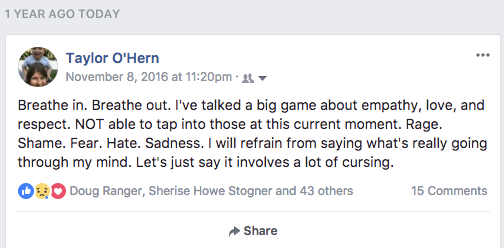
What I’ve learned this year…{the short list}

One of the great things about social media is the ability to go back and track your thoughts over time…and not just your thoughts but the way you interact with others. It also provides us with a way to reflect on how you have grown and changed. Here is the short {definitely not exhaustive} list of things I learned since I wrote this post.

  1. There is a limit to my capacity to feel empathy. This was a hard realization for an empath…but I also learned that these limits don’t last very long. It was only a few days of grieving and processing before I was able to begin perspective taking and moving forward again.
  2. I can’t talk about white privilege without talking about white poverty. This has been a tough one… I feel like it is my responsibility, as a person who has enjoyed a great deal of privilege, to point it out. However, I have learned that it is also really important to take into account the way people’s experiences have shaped their understanding. Sometimes, a larger and and more complex dialogue is necessary… one that starts with listening first, and locating a person, before engaging in sharing your story.
  3. It is ok to be honest, even if it ruffles feathers. For some reason, I have this firmly embedded belief that it is my role to keep the peace, and to smooth over conflict at every turn (even if that means hiding or swallowing parts of myself in the process). While I still feel that it is incredibly important to be respectful and kind, I am also learning that I have a voice. It is ok if sometimes my voice stirs some things up for people. Not everyone is going to like it, but someone, somewhere, may need to hear it.
  4. Relationships are stronger than politics. Lean in. Don’t stop having conversations. If you can’t talk about politics, then talk about people’s kids and their jobs. Talk about their house or sports or whatever it takes to maintain relationship. Of course, there are times to draw boundaries around negativity or toxic relationships, but it is possible to maintain healthy relationships with people who have starkly different values.
  5. Not engaging in politics is not an option. I listened to a nineteen year old kid on a podcast this week totally school me on politics. I have always been a voter…for the big elections. This year I learned how important it was to show up for local and midterm elections. I may not be able to have a voice in what happens in the country at large, but I can pursue change and progress locally. (Y’all…if you want to be schooled by a 19 year old on paying attention to policy over personality, check this out.)
  6.  It sucks to feel stereotyped. I know, right? My experience feeling this way has been so limited. The day after the election, after a night of little sleep, I met my husband at lunch with the kids. We live in an incredibly white, wealthy, republican area. I remember watching each person who walked into the restaurant, and each person of color or person that seemed like they may not be heterosexual that walked in (I know…major stereotyping of my own here….) …I wanted to stand up and tell them, “it wasn’t me! Don’t lump me in with these people,” but I didn’t. I sat there and experienced it. Feeling embarrassed and ashamed.  Feeling powerless over the way others looked at me or felt about me. This was really not a good feeling…but I think it was a really important experience for me to have. I took note of it, I leaned into it, and I won’t forget.
  7. What we need right now is to learn how to listen. We need to learn how to really listen to each other…and how to really speak to each other. People in power, regardless of their group, will always tend to do what it takes to stay in power. There are a lot of interesting (but not new) social dynamics at play right now, and we need to keep showing up for each other. Let’s see who is really causing pain and suffering and who is being scapegoated. Let’s do our best to try on other perspectives and stay curious before becoming defensive.

Why Millennials are leaving the church…

A quick google search will give you endless answers to the question of the millennial exodus from American churches… The data certainly seems to paint a pattern of slow decay that, unless it’s altered, doesn’t look good for the institution. There is a lot of thoughtful commentary as to why this is happening. I think there is a lot of truth to what I have read in most of these articles, as well as some helpful pragmatic approaches toward solutions – the value of excellence, millennials feeling heard, churches focusing on serving the poor, and other data supported assertions.

I think we might be missing something, though.

I have spent a pretty significant time in church [with the exception of the past few months I have attended regularly throughout my life, and served as full time staff for almost ten years]. Yet, even with all of my investment into the life of the church community, and the centrality of church to my identity formation, we had to take a leave. Some of that had to do with the fact we were simply burned out…we exerted too much with little to no attention to self-care and sustainability. Part of it, however, is deeper than that.

Those that know me in person understand that I have gone through a great deal of theological shifting in the past fifteen years. While there is much to appreciate about the framework in which I was raised, I have also wrestled with a great deal of questions and tensions that have left me feeling confused and isolated. At twenty-one, I changed my major to theology and dove headlong into the pursuit of full-time ministry. What I didn’t realize, however, was that studying theology in an academic setting (a quality one, at least) typically leaves you with more questions than answers. This is intentional…and what I am just now learning in my early thirties…this is NORMAL. Differentiation: It is part of natural human growth and development where we question the assumptions about the world that we easily made in our youth. We slowly take items out of our backpack and examine them to decide which assumptions still ring true and which assumptions do not hold up to to what our life experience, education, and wisdom gained through relationships has taught us. Some ideas will be examined for a great deal of time and then placed back inside to continue along the road with us. Some we will want to distance ourselves from…maybe even aggressively. Sometimes the items in our backpack will cause us to feel shame…shame over the way we treated someone based upon our embedded assumptions, shame over the ways that we acted and thought of ourselves…so much shame. Some things we will launch like a rock into a stream and hope no one ever knew it was in our backpack to begin with….and some of these things we will have to put down for a while and build up our strength before we are ready to pick them back up again. I say it again…this is normal.

While I do remember several conversations with my parents about making my faith my own as I became an adult, this growth period of differentiation was not something my faith community seemed to normalize. Don’t get me wrong – my faith community was full of beautiful, kind, generous, loving human beings. Many of them are still very dear to my heart and I am grateful for them.

That is what makes this so sad. I never set out to leave my community. It is not something I wanted or was looking for. I set out to seek after Jesus…after Truth…after Love. My faith community preached a theology of transformation – one that said once you start to walk in this way, you will continually be changed and renewed as you become more like this Jesus we follow.

But evangelical faith community, hear this with love (and I am even saying this to myself today). Sometimes when people undergo spiritual transformation, they don’t come out looking just like you… Sometimes spiritual transformation includes major change in one’s view of social issues. Sometimes it includes major changes to one’s values. Sometimes it includes major changes in life direction or in the manner in which one relates to God. Honestly, I am not real sure how true spiritual transformation can NOT include these things. Isn’t the point to become more like Christ…and not more like each other? And you know what… many people who have grown up in the evangelical community, who have truly sought truth…they are being transformed. Their minds are being renewed. They are becoming more loving people. They are becoming more like Christ. And then they are being shown the door. (Here is an example…)

Maybe it’s not overt, maybe it is… I can’t speak for everyone, but as a person who has spent most of her life in the evangelical “camp” – it wasn’t my behavior or my choices that led me out. I am not “falling off the rails” or “tripping down a slippery slope.” I am slowly and intentionally changing to become more true to the Image in which I was created. There is no cell in my body that does not believe or experience this transformation on a daily basis. This system {no, not my family nor my specific childhood church…but the evangelical culture at large} has made faith so certain, has erased any shroud of mystery and wonder and dialogue, and has boiled everything down to a list of assertions…a statement of faith. Do you cognitively align with these assertions? Great, you’re in. No? Sorry, you can come here but you can’t serve in leadership or have any influence over the life of our community. Not blaming anyone here…I think this is a very human tendency. Our brains crave certainty.

That may not be the message the church is trying to communicate, but that is how I am hearing it. And I know I am not alone here. I am meeting new people, seemingly every day, that call themselves “recovering evangelicals….” or some similar phrase. We are those who grew up in the church, who invested fully, who changed, and now no longer feel welcome.

Here’s the thing. I still love you. I think some of the ways you approach faith might be psychologically damaging (here is an example) and need to be carefully addressed. I think that some of themes might be there more to maintain control and uphold systems of power than to promote experience with and understanding of the Divine – this happens in most (if not all) longstanding institution… But I still love you. I still respect you. I still want to walk with you… I know there are plenty of areas in which I might be wrong and you might be right…

Want to know why I think some millennials that grew up invested in the church are leaving? Because they feel they can’t be intellectually, emotionally, or spiritually honest and remain within their community. It’s not because their heart for the world, the way they love God, or the way they love people is misaligned with their community, it’s because the church is not organized around those things…the church is organized around lists…

What if, instead of organizing around a common set of theological and cognitive assertions, the church could be organized around an intended direction. Messy? Sure…But what if all of our voices were still welcome at the table? There would be a lot of room for dialogue, and you would have to be incredibly creative and patient and loving within the structure of the organization as a business…but isn’t this the point?

Isn’t the point for us to all become more like Christ? Doesn’t it make sense that we all might have different understandings of what that might mean based on all of our unique experiences with the Divine in the world?

People shouldn’t have to chose between honesty and authenticity or their place within their faith community.  Shouldn’t that be the place to be honest and authentic?

I have a lot of work to do here. I have a lot of growth left ahead. I have said plenty of hurtful and damaging things over the years, and am still trying to learn what it means to both be honest to people who have been so meaningful in my life, yet true to where my heart is now. I know I still have a lot of blind spots. Please hear that my intent in this is continuing conversation – It is hope…that maybe we can still find a way to walk this road together. I have a vision that we could stop shoring up the boundaries around our camps and instead find ways to expand them, because we need each other, and because there is so much to be done.

Photo by Emma Frances Logan on Unsplash