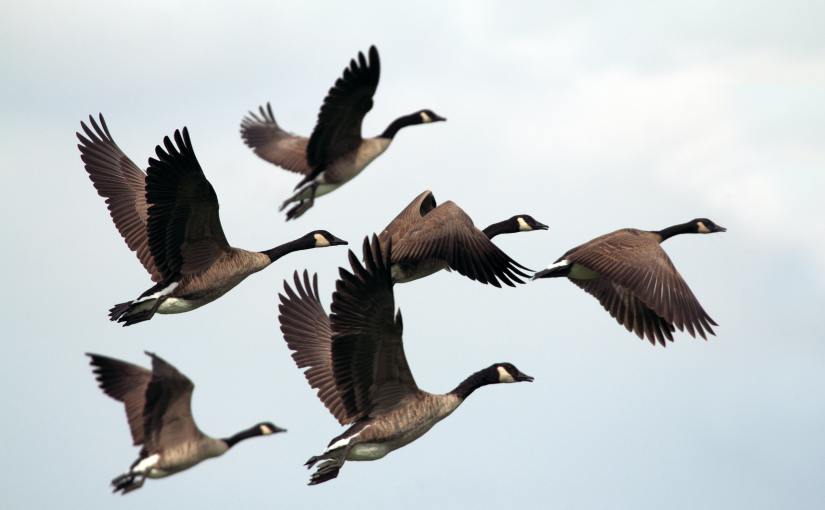
For some time now, I have been completely in love with “Wild Geese,” a poem by Mary Oliver – so much so that I have seriously considered a goose – related tattoo. The image of geese flying in a soaring “V” or a beautiful individual feather have been contenders as something I could carry on my body that would keep the words close to my heart.
But I kind of hate geese in real life. I remember impatiently waiting and fruitlessly honking as geese flooded the parking lot of my apartment complex, blocking the only exit. When my anxiety was finally managed well enough that I could go on walks by myself, I found myself rounding a corner of the path only to be face to face with a whole freaking flock of geese. I tip-toed around the poop-covered pavement and desperately tried to give the animals a wide berth, but apparently it wasn’t wide enough and this big scary dude started hissing at me. So I ran – like a damn fool whose brain apparently thought this goose was wielding a knife or some sort of deadly weapon. I couldn’t even walk the path home and ended up cutting through someone’s vast muddy pasture in an effort to avoid…a goose.
Geese are just one of those things, for me, that I love, wonder, and marvel at from a distance but absolutely despise up close. They terrify me at a very primal, inconquerable level.
I think the reason this poem has become one of my closest friends is the first line “you don’t have to be good.” If you are like me, you’ve never really felt the truth of those words. Being good has always been a given, and expectation – a lifestyle. No matter what the choices, the consequences, the cost the answer is always to be good. Anything that impacts my ability to identify as “good” (by myself or others) at ANY time is perceived as an existential threat. If I am not good – all the time – my very sense of self will be anihillated. I am constantly ruminating on every word, conversations left unsaid or overstated as if I believe that ruffling feathers threatens my life.
Being good looks beautiful from a distance. It sets us up for approval of others, to feel secure in our belonging – both with society and within our understanding of God. It seems uncompromisingly beautiful and laudable. But get up close for a second.
There is an insidious cost for “being good” that can be overlooked when we are at a distance. The energetic cost of filtering every thought, behavior, and plan through what would be “good” or avoid ruffling feathers can actually relieve us of the capacity to be present – with ourselves and with others. It can actually be a form of inauthenticity that keeps us from knowing and being known for who we are – from true connection.
What a different task it is to be alive in love. To choose trusting the Love inside of us instead of the constant calculating of appearing “good” to ourself and others.
It’s an invitation to do less and live more.
Wild Geese, by Mary Oliver
You do not have to be good.
You do not have to walk on your knees
for a hundred miles through the desert repenting.
You only have to let the soft animal of your body
love what it loves.
Tell me about despair, yours, and I will tell you mine.
Meanwhile the world goes on.
Meanwhile the sun and the clear pebbles of the rain
are moving across the landscapes,
over the prairies and the deep trees,
the mountains and the rivers.
Meanwhile the wild geese, high in the clean blue air,
are heading home again.
Whoever you are, no matter how lonely,
the world offers itself to your imagination,
calls to you like the wild geese, harsh and exciting –
over and over announcing your place
in the family of things.
Photo by Gary Bendig on Unsplash

 {re}image