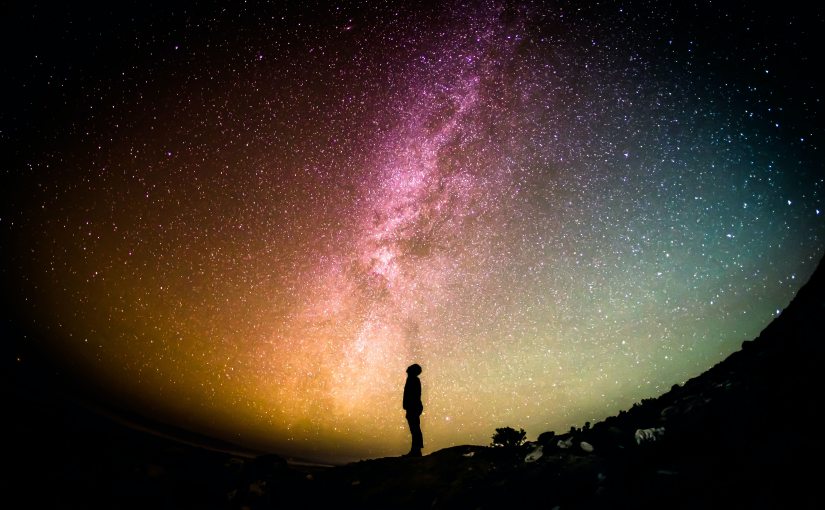
I spent my professional week navigating multiple realities – the imaginal exploration of the varied inner landscape of clients, the “work mode” that can shut off or alter, if but for a brief fifty minutes, the constant prattle of competing thoughts and emotions tussling for space in my consciousness, and the real-life relational realities cultivated in the space between myself and those I love. Most of us have this capacity on some level – stemming from our youthful bounding from princess dancing with the prince, to zookeeper, to doctor, and then back to child sitting in her bedroom. The interplay between these worlds can bring wonder, creativity, joy, play, learning and more, but it can also lead to an uncomfortable amount of cognitive dissonance. What’s more, the part that was able to become the zookeeper and the doctor – she’s still in there somewhere. So is the part that failed a math test, the part who got her heart broken, the part who tasted rejection, the part that fell in love, the part that welcomed a beautiful baby, and the part that gasped in the back of an ambulance in existential fear. We bring all the parts of ourselves with us, and they form a complex network of knowledge, experience, and defensive and adaptive strategies and responses that try to protect us from re-experiencing failure, heartbreak, rejection, and death. We exist in a constant dance among different worlds, conceptions of reality, experiences, affects, and defensive and adaptive strategies without even knowing, or often even noticing, the complicated steps. “We” are not a stagnant, consistent, tangible, predictable entity, but a million constellations constantly moving, expanding and interacting within the universe that we call our “self.” We are moving targets.
Perhaps this is why it’s so easy to lose ourselves, and each other. We don’t know who we are speaking to or from where we, ourselves, are speaking at any given moment.
I don’t know about you, but when I get on social media these days (and let’s be honest, we rely on it a lot more during COVID winter when we aren’t gathering with friends as usual) I can feel my throat tighten with each post I read. My heart starts to race, my fingers begin to tremble, and a feeling that’s not quite panic, but nearer to that than any other word I can access right now, rises steadily within my body. I am not a static “me” reading these posts – I am my fears, my defenses, my need for tribal belonging, my longing for justice, my level of hunger, my level of sleep, the number of days I’ve gone without seeing friends, the tension I feel around parenting, the past experiences I’ve had in conflict and disagreement – I am all of these things, and I would wager you are to.
So what are we to do? How do we peek into the swirling abyss of “person-ness” in a way that makes contact, creates connection, and communication in the way that we are longing for? First, it takes self exploration to learn to identify and chart the nuances that make up our own internal universe so that we can identify from whence and where we are speaking in that moment. We map the stars on an ever-expanding plane that includes a lifetime of experiences, relationships, feelings, and evolving beliefs. What does it feel like to occupy a space of fear? What does it feel like when our 12 year old is coming up to protect us from rejection? From where does this sense of shame I am trying to protect myself from derive – is it a system of belief I held as a child or is it a present value with which I am in conflict? It’s a never-ending adventure navigating through this wondrous journey of being and becoming a person.
Once we have an idea of what part of us is currently running the show, we can attempt to cast our line out to the other person – but not without a similar spirit humble curiosity about who it is that may respond to us. I hope, that by endeavoring to communicate amidst this type of mutual curiosity, we may create space to see each other, to hear each other, to empathize with and humanize each other. If someone responds from a defensive posture, there is a part of them that is feeling threatened or unsafe – and it may or may not have ANYTHING to do with you, and this knowledge may help to cultivate empathy that leads to greater understanding, or at the very least – grace.
We can’t control from whence and where people respond to us, but we can know ourselves. We can discover what it is that provokes our defenses and our own self-protective aggression. We can learn to find empathy and compassion for ourselves and the moments in which we are not in a space to receive any input at all from certain people in our lives in a way that would further connection or understanding between either party. We can explore the ways in which our values have and continue to grow and develop and the ways they intersect with the way we live, move, and act in the world. When we learn ourselves well enough to discern and live into self-compassion, we will also have the ability to show true grace, compassion, and love to others – even those who we feel like live in an alternate universe. In a way, in fact, they do.
 {re}image