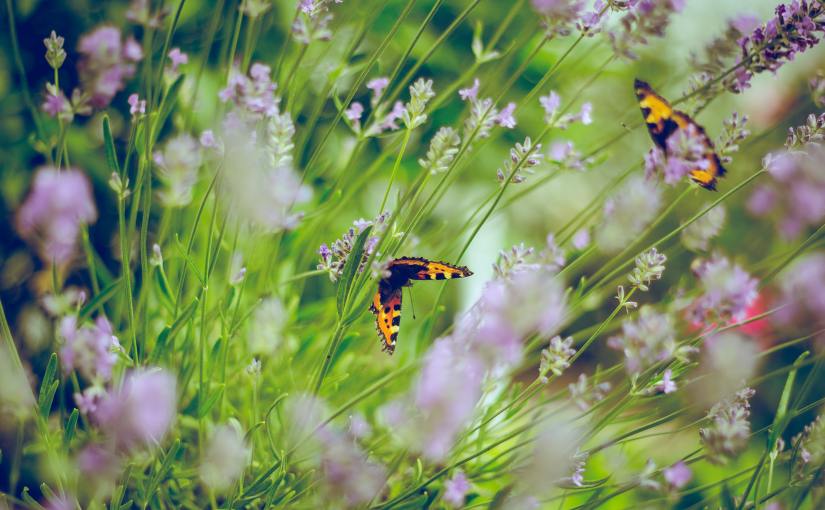
The souls of my shoes made a satisfying crunch as I made my way along the leaf-covered pathway toward the dock that has become my steady place of sacred ground over the last four years. Before rounding the corner, I noticed a single duck floating in the pond beside me. “Huh,” I thought, I don’t usually think of ducks as solitary creatures. My mind began to wander down my own internal hiking trails pondering what it means to be a social creature alone, bringing up the dissonance churning in my stomach at feeling quite distant from my own pack in this season of 2020. Usually I have a stroller full of twenty pound, fire-charged estrogen and light to push along on my walks, but today the nap stars aligned and I found myself alone. I quickly became aware of one of the gifts of walking with this companion as, in her absence, I failed to stop and marvel at each stunning, simple pleasure I passed along the way – a vibrant purple flower, the gentleness of a soft breeze moving across my skin, the nearness of a statuesque squirrel, or the distant yet distinct sound of the rooster crowing at the house I always envy when I pass by. It was strangely quiet.
As I observed a sense of sadness at this absence, I was also able to reengage with the part of my mind that is constantly looking for these pleasures to call out. I stopped naming the experience, but I, instead, simply lived the experience. I relished in the warmth of the sun and found joy in the skittering of rodent claws high overhead. I noticed the way it felt to take a deep breath and felt a depth of gratitude for the space in which I was inhabiting.
Once I arrived at my destination and became present once again with the energetic dissonance that desperately needed a way to crawl out from the thinly worn barrier of my body. I thought about the rhetoric that makes my flesh crawl, and sadness at my utter inability to reconcile the source and audience of these words with the narratives that formed me. I was raised to believe in a story, and wander though I may at times, it is still the scaffolding by which I orient myself. This is a story about a garden.
God, like an artist shooting up from bed at 11pm because the inspiration was churning and demanded expression , created this garden. God filled the garden with an immense diversity life and named the entire thing good. Then God created humans. From the narrative, it would seem that the role of humans was to be the consciousness – the experiencer of the experience. God gives these experiencers the task of noticing, calling out, and naming each aspect of creation – a task I find myself continuing as I use language to model for my daughter the gift of experiencing through noticing and naming on our walks. It’s innate in us, this ability to notice, name, and assign meaning. God called all of this good, and sent the humans forth to experience, enjoy, and flourish.
There was a warning, though. There was this one particular tree that they were never to eat from – the only prohibition in all of creation. The story calls it the tree of the knowledge of good and evil. It was not called the tree of evil, or the tree of the devil, or the tree of sin. It was the tree of the knowledge of good and evil. The story’s antagonist, of course, attempts to lure the human experiencers to taste of this tree with the promise that they will be like God – that the knowledge, or certainty, of what is good and what is evil is God-like: Powerful. Just as God warned, after tasting the fruit of this knowledge, the humans lost the privilege of simply enjoying the garden.
Many people view this story as a time-limited, chronological event, but what if it is more than that? What if this is an invitation and a prohibitive warning that lives in perpetuity. The invitation: live, experience, feel, enjoy, abide in the entirety of this creation. The warning: if you are enticed by the fruit of this tree of knowledge, if you want to claim the power and authority to name what is good and what is evil – the result will be separation, death, and destruction.
Certainty is power. It is the ability to have the answers, to reassure ourselves that we are the “good” ones, and to craft narratives that are coherent and cohesive. But certainty is not without a cost – and the cost is separation and destruction. Death – not in the way of the physical body, but of the ceasing of our ability to simply abide, purely enjoy, and wholly experience.
You can choose to live amongst the bounty of the entire garden, or you can choose the one tree, the power to claim Ultimate knowledge, Ultimate judgment, Ultimate certainty.
Myself, I choose the garden.

 {re}image