A quick google search will give you endless answers to the question of the millennial exodus from American churches… The data certainly seems to paint a pattern of slow decay that, unless it’s altered, doesn’t look good for the institution. There is a lot of thoughtful commentary as to why this is happening. I think there is a lot of truth to what I have read in most of these articles, as well as some helpful pragmatic approaches toward solutions – the value of excellence, millennials feeling heard, churches focusing on serving the poor, and other data supported assertions.
I think we might be missing something, though.
I have spent a pretty significant time in church [with the exception of the past few months I have attended regularly throughout my life, and served as full time staff for almost ten years]. Yet, even with all of my investment into the life of the church community, and the centrality of church to my identity formation, we had to take a leave. Some of that had to do with the fact we were simply burned out…we exerted too much with little to no attention to self-care and sustainability. Part of it, however, is deeper than that.
Those that know me in person understand that I have gone through a great deal of theological shifting in the past fifteen years. While there is much to appreciate about the framework in which I was raised, I have also wrestled with a great deal of questions and tensions that have left me feeling confused and isolated. At twenty-one, I changed my major to theology and dove headlong into the pursuit of full-time ministry. What I didn’t realize, however, was that studying theology in an academic setting (a quality one, at least) typically leaves you with more questions than answers. This is intentional…and what I am just now learning in my early thirties…this is NORMAL. Differentiation: It is part of natural human growth and development where we question the assumptions about the world that we easily made in our youth. We slowly take items out of our backpack and examine them to decide which assumptions still ring true and which assumptions do not hold up to to what our life experience, education, and wisdom gained through relationships has taught us. Some ideas will be examined for a great deal of time and then placed back inside to continue along the road with us. Some we will want to distance ourselves from…maybe even aggressively. Sometimes the items in our backpack will cause us to feel shame…shame over the way we treated someone based upon our embedded assumptions, shame over the ways that we acted and thought of ourselves…so much shame. Some things we will launch like a rock into a stream and hope no one ever knew it was in our backpack to begin with….and some of these things we will have to put down for a while and build up our strength before we are ready to pick them back up again. I say it again…this is normal.
While I do remember several conversations with my parents about making my faith my own as I became an adult, this growth period of differentiation was not something my faith community seemed to normalize. Don’t get me wrong – my faith community was full of beautiful, kind, generous, loving human beings. Many of them are still very dear to my heart and I am grateful for them.
That is what makes this so sad. I never set out to leave my community. It is not something I wanted or was looking for. I set out to seek after Jesus…after Truth…after Love. My faith community preached a theology of transformation – one that said once you start to walk in this way, you will continually be changed and renewed as you become more like this Jesus we follow.
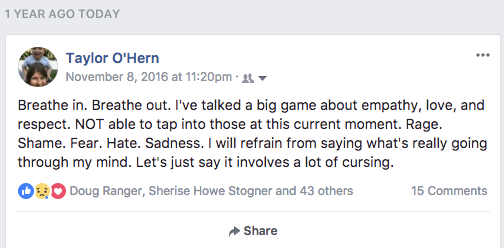
But evangelical faith community, hear this with love (and I am even saying this to myself today). Sometimes when people undergo spiritual transformation, they don’t come out looking just like you… Sometimes spiritual transformation includes major change in one’s view of social issues. Sometimes it includes major changes to one’s values. Sometimes it includes major changes in life direction or in the manner in which one relates to God. Honestly, I am not real sure how true spiritual transformation can NOT include these things. Isn’t the point to become more like Christ…and not more like each other? And you know what… many people who have grown up in the evangelical community, who have truly sought truth…they are being transformed. Their minds are being renewed. They are becoming more loving people. They are becoming more like Christ. And then they are being shown the door. (Here is an example…)
Maybe it’s not overt, maybe it is… I can’t speak for everyone, but as a person who has spent most of her life in the evangelical “camp” – it wasn’t my behavior or my choices that led me out. I am not “falling off the rails” or “tripping down a slippery slope.” I am slowly and intentionally changing to become more true to the Image in which I was created. There is no cell in my body that does not believe or experience this transformation on a daily basis. This system {no, not my family nor my specific childhood church…but the evangelical culture at large} has made faith so certain, has erased any shroud of mystery and wonder and dialogue, and has boiled everything down to a list of assertions…a statement of faith. Do you cognitively align with these assertions? Great, you’re in. No? Sorry, you can come here but you can’t serve in leadership or have any influence over the life of our community. Not blaming anyone here…I think this is a very human tendency. Our brains crave certainty.
That may not be the message the church is trying to communicate, but that is how I am hearing it. And I know I am not alone here. I am meeting new people, seemingly every day, that call themselves “recovering evangelicals….” or some similar phrase. We are those who grew up in the church, who invested fully, who changed, and now no longer feel welcome.
Here’s the thing. I still love you. I think some of the ways you approach faith might be psychologically damaging (here is an example) and need to be carefully addressed. I think that some of themes might be there more to maintain control and uphold systems of power than to promote experience with and understanding of the Divine – this happens in most (if not all) longstanding institution… But I still love you. I still respect you. I still want to walk with you… I know there are plenty of areas in which I might be wrong and you might be right…
Want to know why I think some millennials that grew up invested in the church are leaving? Because they feel they can’t be intellectually, emotionally, or spiritually honest and remain within their community. It’s not because their heart for the world, the way they love God, or the way they love people is misaligned with their community, it’s because the church is not organized around those things…the church is organized around lists…
What if, instead of organizing around a common set of theological and cognitive assertions, the church could be organized around an intended direction. Messy? Sure…But what if all of our voices were still welcome at the table? There would be a lot of room for dialogue, and you would have to be incredibly creative and patient and loving within the structure of the organization as a business…but isn’t this the point?
Isn’t the point for us to all become more like Christ? Doesn’t it make sense that we all might have different understandings of what that might mean based on all of our unique experiences with the Divine in the world?
People shouldn’t have to chose between honesty and authenticity or their place within their faith community. Shouldn’t that be the place to be honest and authentic?
I have a lot of work to do here. I have a lot of growth left ahead. I have said plenty of hurtful and damaging things over the years, and am still trying to learn what it means to both be honest to people who have been so meaningful in my life, yet true to where my heart is now. I know I still have a lot of blind spots. Please hear that my intent in this is continuing conversation – It is hope…that maybe we can still find a way to walk this road together. I have a vision that we could stop shoring up the boundaries around our camps and instead find ways to expand them, because we need each other, and because there is so much to be done.
Photo by Emma Frances Logan on Unsplash





 {re}image